HOME > Weekly Case > Weekly Case
Weekly Case
종결
Case No. 756
2026-07-01~2026-07-31
출제자 : 서배선
Hit : 276
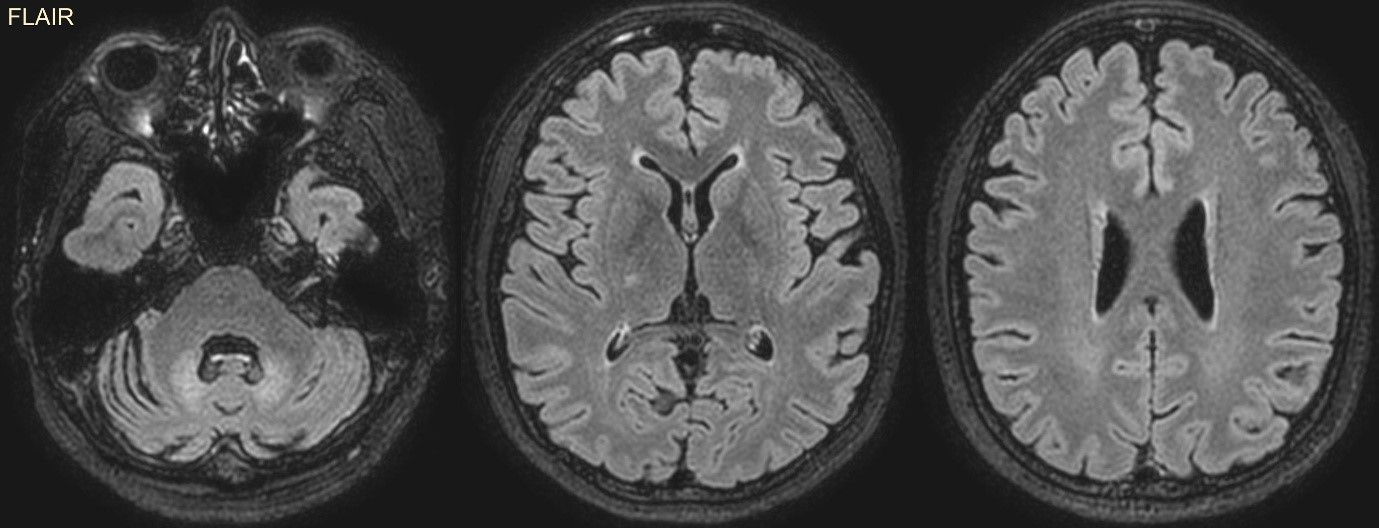
| Period | 2026-07-01~2026-07-31 |
|---|---|
| Diagnosis | Cerebrotendinous xanthomatosis |
| Gender |
|
| Age | 37 |
| Clinical information | F/37 Chief complaint) Gait disturbance developed around 2019. Past history) s/p op. d/t Lt. (’19) and Rt. (’25) achilles tendon xanthoma What's your diagnosis? |
| Discussion | Typical brain imaging findings T2/FLAIR hyperintensities involving the dentate nuclei (a characteristic finding), basal ganglia, cerebral peduncles, cerebellar white matter, and periventricular white matter. Dentate nucleus lesions may show heterogeneous T2/FLAIR signal characteristics, including a hypointense rim and areas of hypointensity related to (micro)calcification. Cerebral and cerebellar atrophy. Tendon xanthomas, particularly involving the bilateral Achilles tendons, may also be observed. Reference) Barkhof F, Verrips A, Wesseling P, van Der Knaap MS, van Engelen BG, Gabreëls FJ, Keyser A, Wevers RA, Valk J. Cerebrotendinous xanthomatosis: the spectrum of imaging findings and the correlation with neuropathologic |
| Correct answer |
Correct Answer
Semi-Correct Answer |
Submit answer
Answer submission list
The written answers can only be viewed by the administrator and author.
The written answers can only be viewed by the administrator and author.