HOME > Weekly Case > Weekly Case
Weekly Case
종결
Case No. 724
2025-07-01~2025-07-31
출제자 : 서배선
Hit : 421
| Period | 2025-07-01~2025-07-31 |
|---|---|
| Diagnosis | Cerebral hyperperfusion syndrome |
| Gender |
|
| Age | 40 |
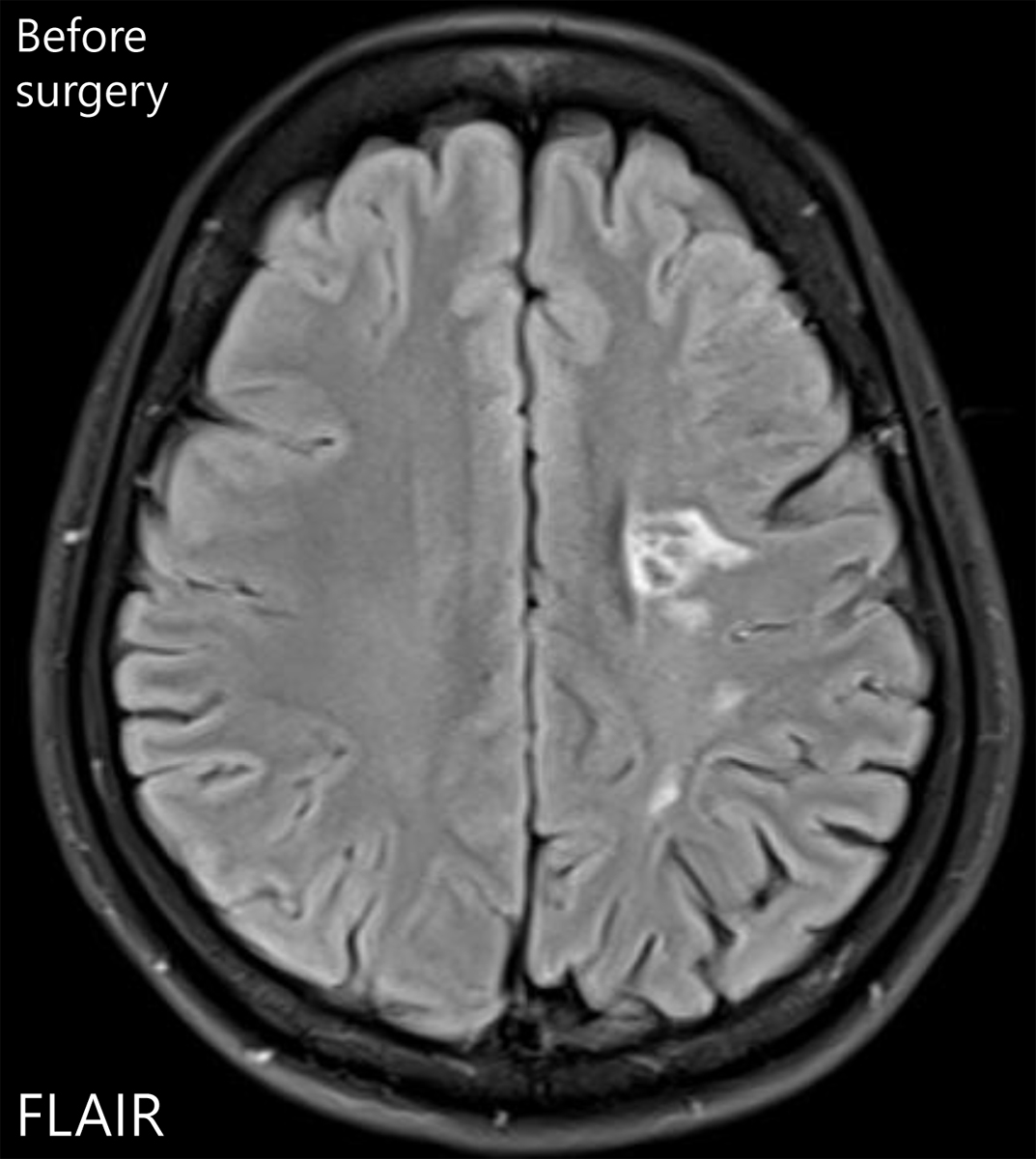
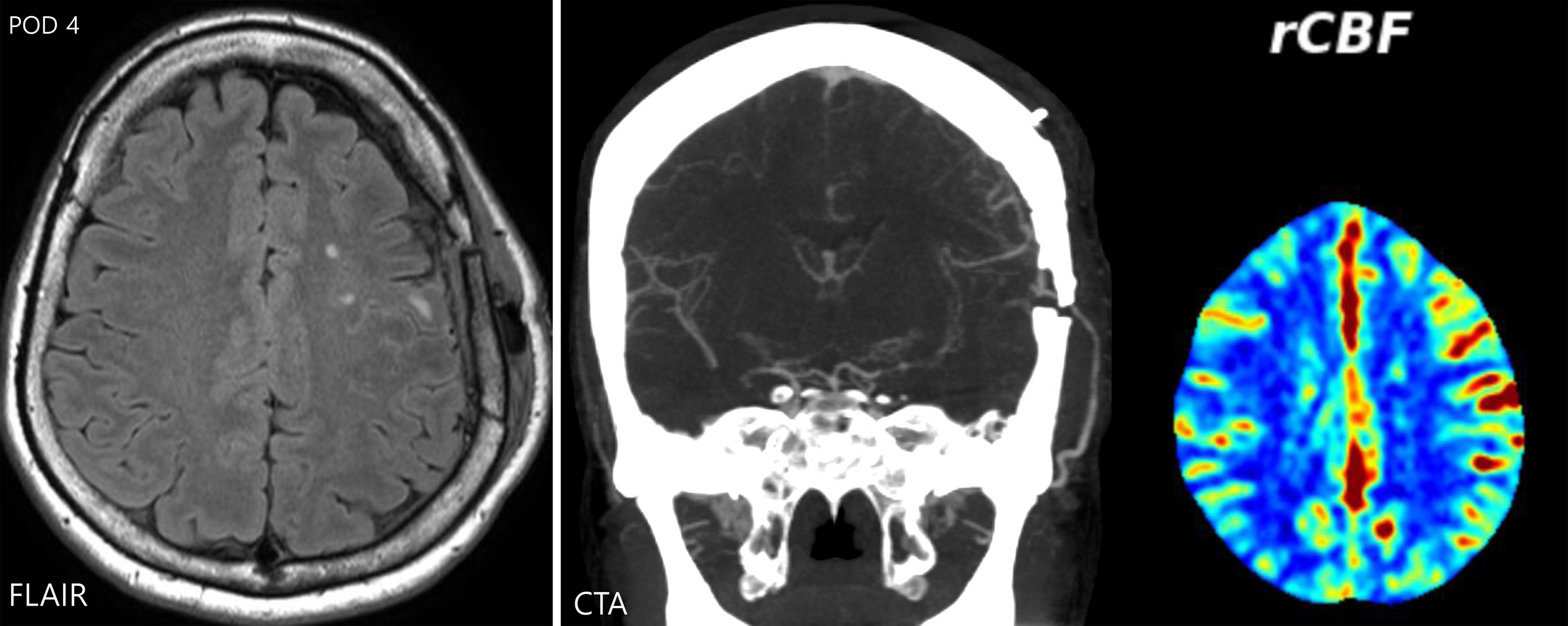
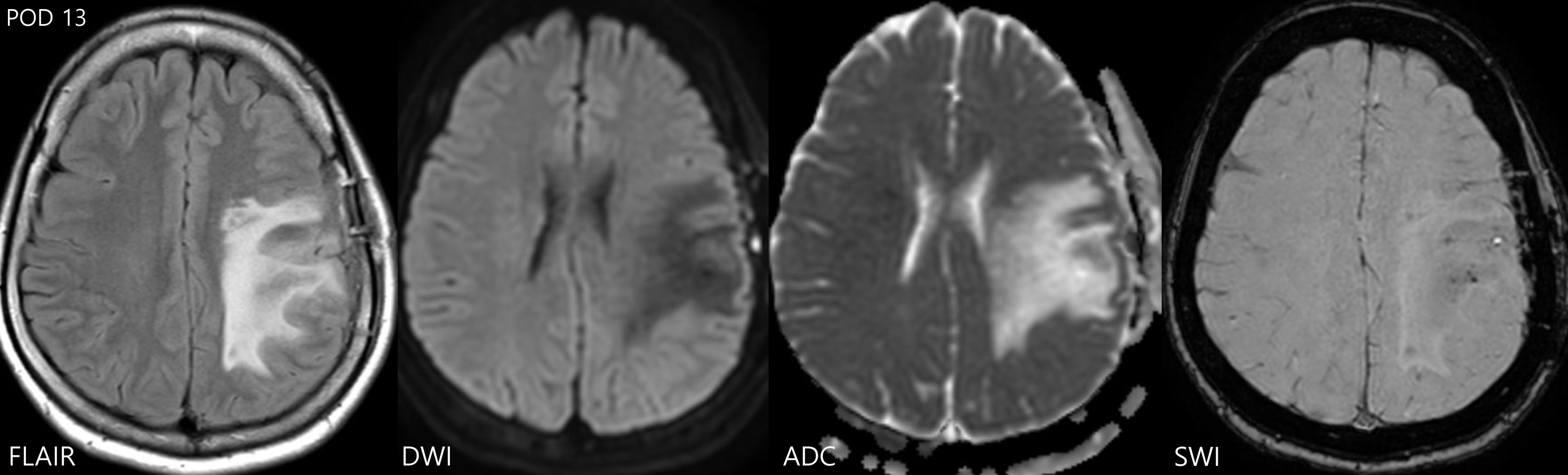
| Clinical information | F/40 Moyamoya disease patient. Seizure, aphasia, right side weakness after EIAB (extracranial intracranial arterial bypass). What is your diagnosis? |
| Discussion | The patient underwent extracranial intracranial arterial bypass (EIAB) for Moyamoya disease. Four days after surgery, newly developed focal FLAIR hyperintensity was noted in the left frontal lobe subcortical white matter. CT perfusion revealed mildly increased cerebral blood flow (CBF) in the left cerebral hemisphere. Six days after surgery, the patient developed a generalized tonic-clonic seizure, aphasia, and right side weakness. Follow-up MRI demonstrated a marked increase in extent of FLAIR hyperintensity, with petechial hemorrhage and no diffusion restriction. The patient diagnosed with cerebral hyperperfusion syndrome and showed improvement in neurologic deficits following rehabilitation therapy. Cerebral hyperperfusion syndrome is a rare but potentially severe complication of revascularization procedures. It may develop immediately after surgery or up to several weeks later. Although the exact pathophysiology is not fully understood, impaired cerebrovascular autoregulation is considered a key contributing factor. Clinical manifestations include severe headache, focal neurological deficits, seizures, and altered consciousness. Characteristic imaging findings include patchy or diffuse white matter edema without diffusion restriction, along with increased CBF. Focal infarction and hemorrhage may also be present. However, normal findings on MRI and CT do not exclude the presence of cerebral hyperperfusion syndrome. Reference) Lin YH, Liu HM. Update on cerebral hyperperfusion syndrome. J Neurointerv Surg. 2020 Aug;12(8):788-793. |
| Correct answer |
Correct Answer
Semi-Correct Answer |