HOME > Weekly Case > Weekly Case
Weekly Case
종결
Case No. 685
2024-04-01~2024-04-30
출제자 : 임영희
Hit : 590
| Period | 2024-04-01~2024-04-30 |
|---|---|
| Diagnosis | PRES |
| Gender |
|
| Age | 36 |
| Clinical information | 36F postpartum, seizure 진단은? |
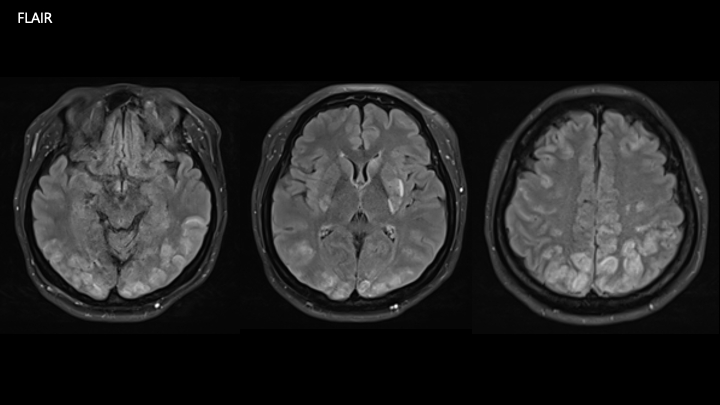
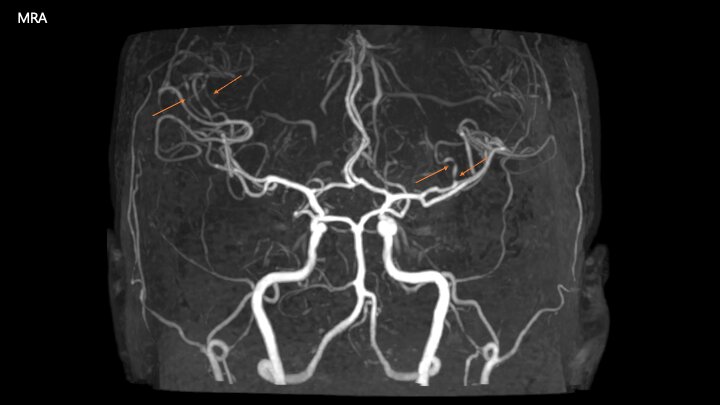
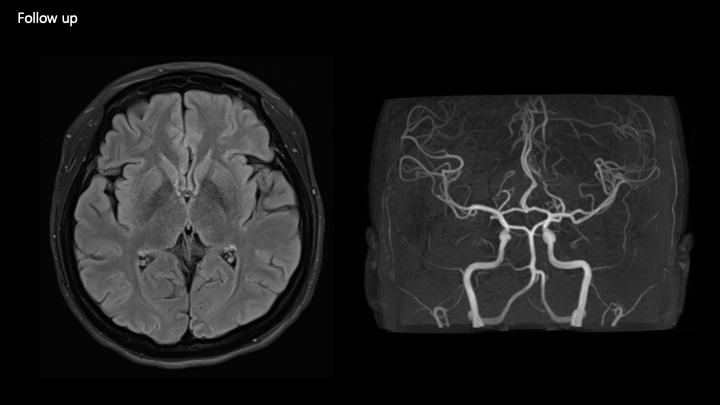
| Discussion | Multifocal large area of T2/FLAIR high SI lesions in the bilateral cerebral and cerebellar hemispheres including BG, more predominent cortex/subcortex. - with mainly vasogenic edema of high ADC value. - normalization on follow up MRI PRES (posterior reversible encephalopathy syndrome) MRA; Multifocal narrowing in the bilateral distal MCA branches - normalization on follow up MRA combined RCVS vs. secondary change of PRES PRES (posterior reversible encephalopathy syndrome) A rare disorder associated with acute hypertension, its pathogenesis not clear Variant of hypertensive encephalopathy characterized by headache, visual disturbances, altered mental function Cerebrovascular autoregulatory disorder; Multiple etiologies, Most caused by acute hypertension (HTN) Modality Characteristics CT Bilateral nonconfluent hypodense foci, predilection to posterior parietal, occipital lobes and cortical watershed zones. CTA Major vessels usually normal Diffuse vasoconstriction of distal vessels, focal irregularity and beaded appearance MRI Typical PRES: T2/FLAIR Hyperintense cortical/subcortical lesions, Parietooccipital lobes, cortical watershed zones Atypical PRES: T2/FLAIR lesion in frontal lobe, basal ganglia involvement, Extensive brainstem, cerebellar edema T2* GRE; Focal parenchymal hemorrhage, microhemorrhages, convexity subarachnoid hemorrhage (SAH) DWI ; Mostly no diffusion restriction, markedly elevated ADC CE T1WI; variable patchy enhancement Postpartum RCVS (postpartum angiopathy) Puerperium is risk factor in 7 to 9% of all RCVS cases Due to 1) female reproductive hormones 2) pregnancy -related physiological changes; blood volume, blood pressure, blood vessels alterations in cerebral arterial tone Observed within 0 to 30 days postpartum, median occurrence of 5 days Patients without history of headache usually present with seizures, focal neurological deficits, confusion, or coma in the setting of stroke or PRES. significant clinical and radiological overlap between RCVS and PRES; Reversible vasogenic edema has been demonstrated in 9 to 38% of patients with RCVS Reference Sharma M et al. Indian J Radiol Imaging. 2021 Oct 6;31(3):764-767. Marcoccia E et al. Obstet Gynecol. 2019 Jan 27;2019:9527632. Pilato F et al. Front Neurol. 2020 Feb 14;11:34 |
| Correct answer |
Correct Answer
Semi-Correct Answer |