HOME > Weekly Case > Weekly Case
Weekly Case
종결
Case No. 266
2012-04-02~2012-04-30
출제자 : 최승홍
Hit : 497
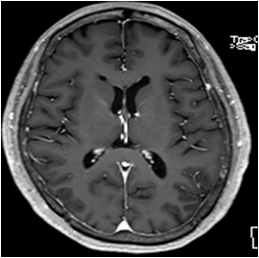
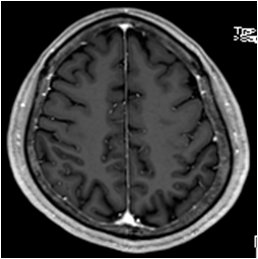
| Period | 2012-04-02~2012-04-30 |
|---|---|
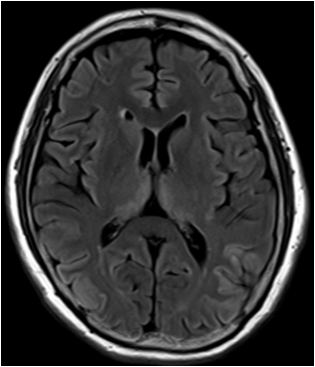
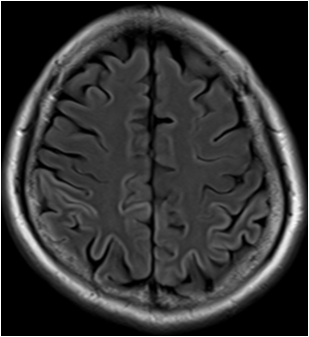
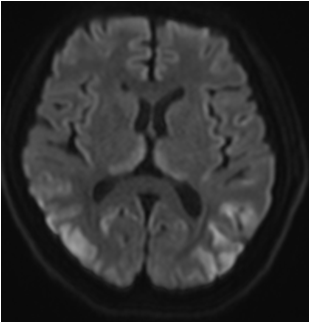
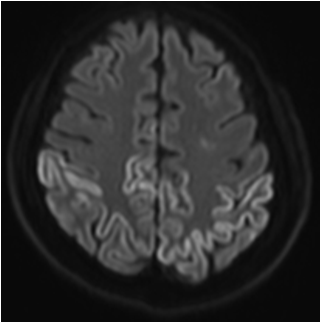
| Diagnosis | Creutzfeldt-Jakob disease |
| Clinical information | F/66 CC: memory impairment |
| Discussion | Creutzfeldt Jakob disease (CJD) is one of the spongiform encephalopathies, a group of diseases that share a number of features including a progressive neurological course, characteristic histopathology and causal agents that have an unusual resistance to sterilization. High signal in the striatum, the cerebral cortex and to a lesser extent in the thalamus are the classical findings in sporadic CJD. Especially the cortical signal changes are best appreciated on DW images, followed by FLAIR images, while striatal and thalamic high signal is also seen on T2- and PDw-sequences. Using DW and FLAIR sequences, one finds that the sensitivity, specificity and accuracy for high signal changes in the diagnosis of CJD is >91%. Symmetrical high signal of the pulvinar thalami (relative to the cortex and especially the anterior part of the putamen) is characteristic of vCJD and is known as the “pulvinar sign”. The pulvinar sign has a sensitivity of 78–90% and a specificity of 100% for vCJD. It has been described on T2-weighted, proton-density weighted, FLAIR and DW images. |
| Correct answer |
Correct Answer
Semi-Correct Answer |