HOME > Weekly Case > Weekly Case
Weekly Case
종결
Case No. 253
2011-09-01~2011-09-30
출제자 : 최진우
Hit : 674
| Period | 2011-09-01~2011-09-30 |
|---|---|
| Diagnosis | Hallervorden-Spatz disease |
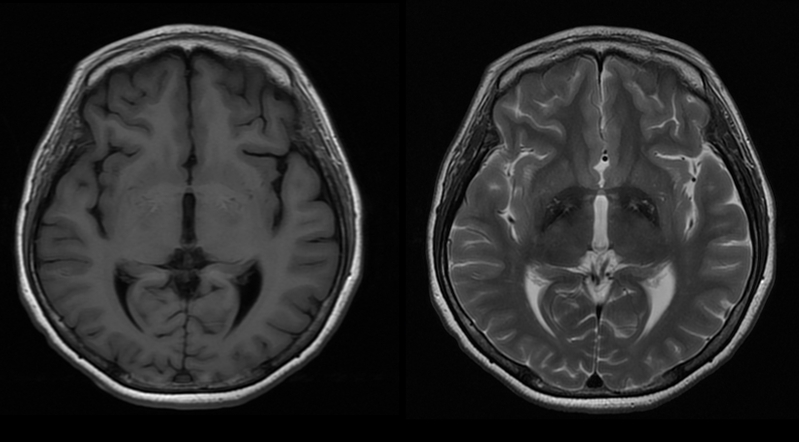
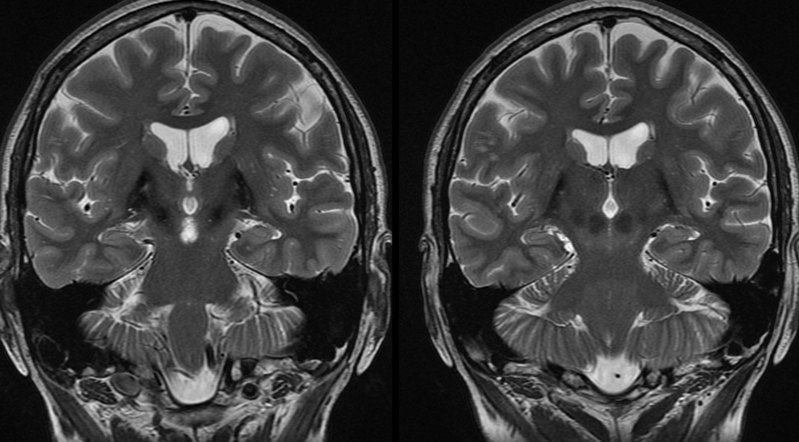
| Clinical information | F/44 C.C.: Headache, memory loss onset) 2 years ago |
| Discussion | Final Diagnosis: Mutation in c.[1257del]+[1319G>C](p.[Phe419LeufsX31]+[Arg440Pro]) R/O c.1319G>C(p.Arg440Pro) polymorphism à Pantothenate kinase-associated neurodegeneration (PKAN, Hallervorden-Spatz disease) Review Pantothenate kinase-associated neurodegenreration(PKAN) 1. M/C form of neurodegeneration with brain iron accumuation PKAN(Hallervorden-Spatz syndrome) Aceruloplasminemia, neuroferritinopathy, infantile neuroaxonal dystrophy 2. Etiology Mutations in the gene encoding pantothenate kinase 2 Critical role in Coenzyme A systhesis àEssential to energy, neurotransmitter and glutathione metabolism. PANK2 mutation à CoA deficiency à energy and lipid dyshomeostasis à oxygen free radical à cell membrane destruction Cysteine accumulation in GP causes iron chelation and peroxidative cell membrane damage 3. Imaging Findings 1) Bilateral hypointensity in the globus pallidus at T2 weighted imaging, which correlates with iron accumulation observed at pathologic examination 2) “Eye of the tiger” sign with a high SI center surrounded by the more typical hypointensity in the globus pallidus à Specific sign for PANK2 mutation 3) Variable hypo SI in substantia nigra and subthalamic nucleus 4) T2* GRE and susceptibility weighted imaging show low SI “blooming” artifact due to paramagnetic effect iron |
| Correct answer |
Correct Answer
Semi-Correct Answer |