HOME > Weekly Case > Weekly Case
Weekly Case
종결
Case No. 201
2010-01-27~2010-02-07
출제자 : 관리자
Hit : 476
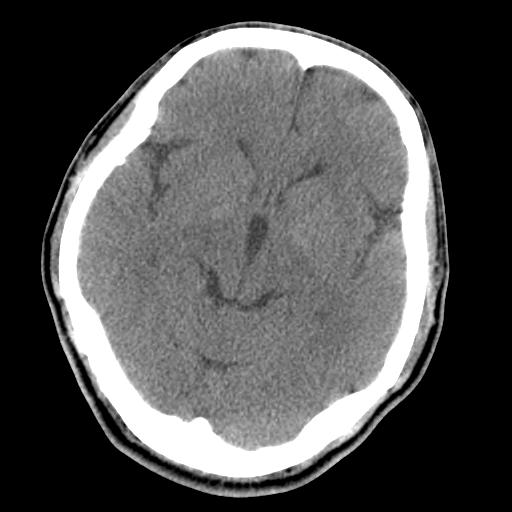
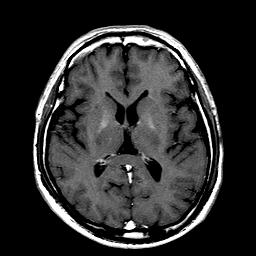
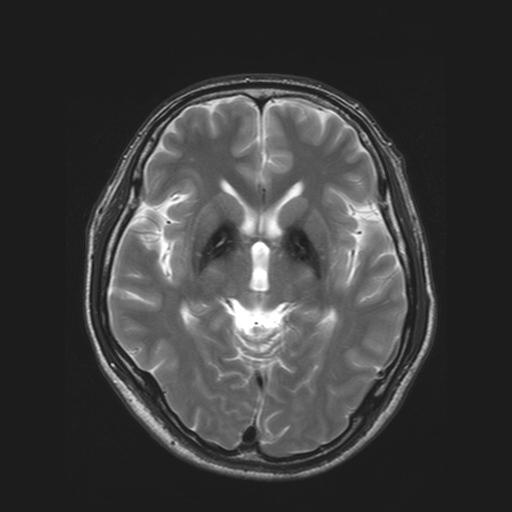
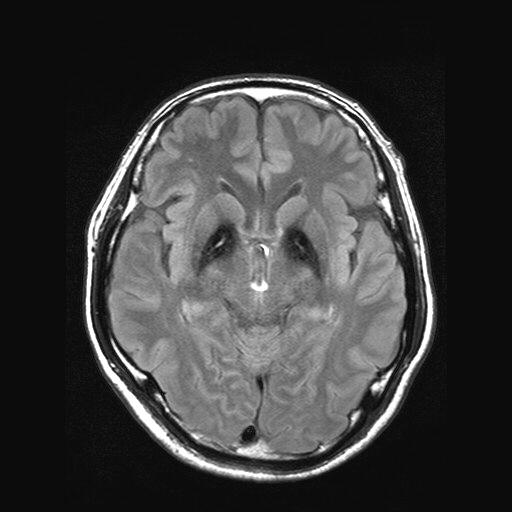
| Period | 2010-01-27~2010-02-07 |
|---|---|
| Diagnosis | |
| Clinical information | Male/55, dystonia for 30 years |
| Discussion | 진단명: Hallervorden-Spatz Syndrome - Recently, renamed as “neurodegeneration with brain iron accumulation (NBIA)” - Subdivided into one classic and two atpical types Image findings: T2WI and FLAIR image reveal so-called “eye-of-the tiger sign” which describes low signal intensity surrounding a central region of high signal intensity in the anteromedial globus pallidus. On T1WI, the region shows high SI, which may be variable. On precontrast CT, the region shows equivocally hyperdense or normal attenuation. Review: - Classsic type (pantothenate kinase.associated neurodegeneration classic subtype, PKAN-classic) : early onset (usually before the age of 6 years), dominant extrapyramidal signs such as dystonia, rapid progression to severe disability, mutations in the gene encoding pantothenate kinase 2 (PANK2 gene) , “eye-of-the tiger sign” +. - Atypical type: usually late onset (mean age of onset of 13.7 years), less severe dystonia and rigidity, slower progression 1. PKAN-atypical: 35% of patients with atypical disease, positive mutation in PANK2 gene, “eye-of-the tiger sign” +. 2. neurodegeneration with brain iron accumulation type 1 (NBAI-1): without the mutation for the PANK2 gene, “eye-of-the tiger sign” -. Both PKAN-classic and PKAN-atypical patients showed the eye-of-the-tiger sign on T2WI. In contrast, mutation-negative, NBAI-1 patients do not show the eye-of-the-tiger sign in and show abnormal hypointensity of the globus pallidus without the associated hyperintense signal on T2-weighted images. REF) Atlas SW, Normal Aging, Dementia, and Neurodegenerative Disease, Magnetic Resonance Imaging of the Brain and Spine 4th edition, Philadelphia, Lippincott Williams & Wilkins, 2009;1026-1087 |
| Correct answer |
Correct AnswerSemi-Correct Answer |