HOME > Weekly Case > Weekly Case
Weekly Case
종결
Case No. 177
0000-00-00~0000-00-00
출제자 : 관리자
Hit : 287
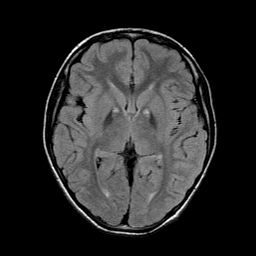
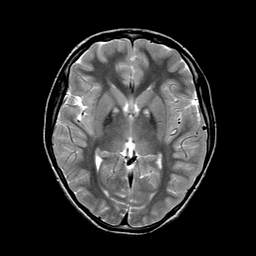
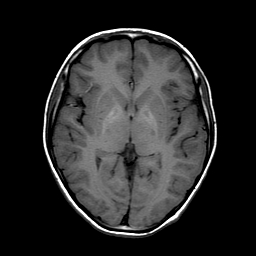
| Period | 0000-00-00~0000-00-00 |
|---|---|
| Diagnosis | |
| Clinical information | 9세 여아, gait disturbance |
| Discussion | Hallervoden-Spatz disease Hallervorden뻊patz syndrome is an autosomal recessive disorder characterized by dystonia, parkinsonism, and iron accumulation in the brain. Many patients with this disease have mutations in the gene encoding pantothenate kinase 2 (PANK2). The most common features of Hallervorden-Spatz syndrome are as follows: (1) onset during the first two decades of life, (2) progression of signs and symptoms, (3) evidence of extrapyramidal dysfunction, including one or more of the following: dystonia, rigidity, and choreoathetosis, and (4) specific MRI pattern of hyperintensity within the hypointense medial globus pallidus. MRI studies have often demonstrated hypointensity in the basal ganglia, most pronounced in the globus pallidus, which is suggestive of storage of an unusual material, probably iron. The patients also manifest an area of higher signal intensity in the central or anteromedial part of the globus pallidus, which has been termed the eye of the tiger. In the globus pallidus, the area of hypointensity appears to correspond with pallidal necrosis and accumulation of iron deposits, whereas the area of high-signal intensity suggests loose tissue with vacuolization and lesser amounts of iron and gliosis. References 1. Hayflick SJ, Westaway SK, Levinson B, Zhou B, Johnson MA, Ching KH, Gitschier J. Genetic, clinical, and radiographic delineation of Hallervorden-Spatz syndrome. N Engl J Med 2003;348:33-40. 2. Swaiman KF. Hallervorden-Spatz syndrome. Pediatr Neurol 2001;25:102-8. |
| Correct answer |
Correct AnswerSemi-Correct Answer |